


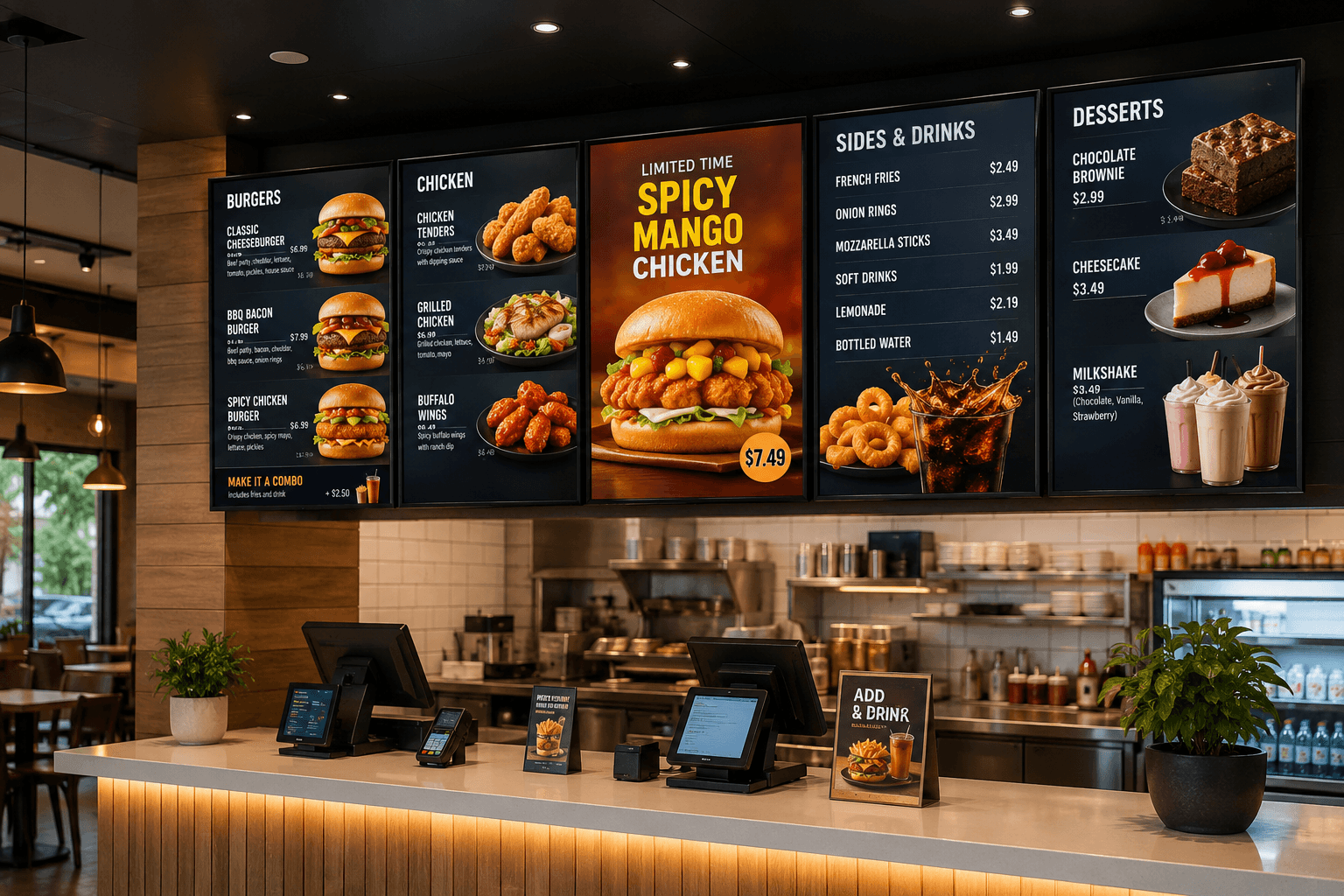
Walk into almost any quick-service restaurant, coffee shop, or food court today, and you’ll notice something that would have looked futuristic just a decade ago. Instead of printed menus with plastic letters slotted into a backlit panel, you’ll see bright, moving screens displaying food photos, prices, and promotions. These are digital menu boards, and they have quietly become one of the most practical upgrades a food business can make.
This shift didn’t happen overnight. It grew out of a simple business need: menus change often, and updating a printed board every time a price shifts or a seasonal item is added is slow, expensive, and prone to mistakes. This new format solved that problem by turning static signage into something that can be edited in minutes from a computer or tablet.
What Are Digital Menu Boards
At their core, these displays are electronic screens, usually LED or LCD panels, that show a restaurant’s menu items, prices, and images instead of relying on printed signs. They are connected to a content management system, which is software that lets staff or managers update the screen content remotely, without touching the hardware itself.
Unlike a printed menu, which stays fixed until someone physically replaces it, digital menu boards can change automatically based on the time of day. A coffee shop might show breakfast items until 11 a.m. and then switch to lunch offerings without anyone lifting a finger. This kind of automation is one of the biggest reasons businesses have moved away from traditional printed signage.
Why Businesses Are Switching to Digital Menu Boards
The reasons behind this shift are mostly practical. Food costs fluctuate, new items get added, and old ones get discontinued. Every time that happens with a printed menu, someone has to design new signage, print it, and physically install it. That process can take days and cost real money.
With this kind of system, the same update takes just a few clicks. A manager can log into a dashboard, change a price, swap out a photo, or highlight a new promotion, and the screen updates instantly. This flexibility matters even more for businesses with multiple locations, since a single update can be pushed to every store at once instead of coordinating separate print jobs for each site.
There’s also a marketing angle here. Bright visuals and short videos naturally draw more attention than static text. Many restaurant owners have found that customers notice combo deals and limited-time offers faster when they’re shown on an animated screen rather than a printed insert taped to the counter.
How Digital Menu Boards Work
Setting up this kind of display usually involves three parts working together. First, there’s the display hardware, which is typically a commercial-grade screen designed to run for long hours without overheating or burning in. Second, there’s a media player or small computer connected to the screen that handles the actual content playback. Third, there’s the software layer, often cloud-based, where staff create and schedule the content that appears on screen.
Once these pieces are in place, updating the menu becomes as simple as editing a document. Many systems also allow scheduling, so a business can set breakfast, lunch, and dinner menus to switch automatically at set times. Some setups even integrate with point-of-sale systems, so if an item sells out, it can be automatically removed from the board without staff needing to do it manually.
Internet connectivity plays a role too. Cloud-connected systems can be managed from anywhere, meaning a regional manager overseeing ten locations doesn’t need to visit each store to make a change. This remote control is part of what makes the technology so appealing to multi-location businesses.
Key Benefits for Restaurants and Cafés
One of the clearest advantages is cost savings over time. While the upfront investment in screens and software is higher than printing a static sign, businesses save significantly on repeated printing costs, especially those that update their menus frequently.
Speed of updates is another major benefit. Seasonal items, price adjustments, and promotional pushes can go live within minutes. This is particularly useful during busy periods like holidays, when menus often need last-minute tweaks.
Digital menu boards also help with order accuracy. Clear, well-lit images and legible pricing reduce confusion at the counter, which can lower the number of mistaken orders and speed up the line during rush hours. Some businesses report shorter wait times simply because customers can decide faster when the menu is easy to read from a distance.
There’s a sustainability angle worth mentioning as well. Cutting down on paper and plastic signage, especially for businesses that change menus seasonally, reduces waste. Businesses that regularly update seasonal offerings can also learn from food-focused content such as Best Guiso de Lentejas Near Me, which discusses how seasonal menu choices influence customer preferences. For companies trying to present themselves as environmentally conscious, this is a small but visible step in that direction.
Finally, there’s the branding benefit. Screens allow for consistent colors, fonts, and imagery across every location, which helps reinforce brand identity in a way that printed boards, especially older or mismatched ones, often can’t match.
Comparing Digital Displays and Traditional Signage
It helps to compare the two side by side. Traditional printed boards are cheaper to install initially, don’t require electricity or internet access, and are simple to understand. For a very small business with a menu that rarely changes, this simplicity can still make sense.
However, the moment a business needs frequent updates, multiple locations, or dynamic pricing, printed boards start to show their limits. Every change means new printing, new installation, and time spent taking down old materials. Mistakes are also harder to fix quickly since reprinting takes time.
This approach flips that equation. The initial setup costs more, but ongoing changes are nearly free in terms of labor and materials. Over a year or two, especially for businesses that update pricing or promotions often, the total cost of ownership often favors digital signage over repeated printing.
There’s also a customer experience difference. Digital screens can show appetizing food photography, short promotional clips, and even nutritional information in ways that static boards simply can’t replicate with the same visual impact.
Choosing the Right Digital Menu Boards for Your Business
Not every business needs the same setup. A small café with one location has very different requirements than a fast-food chain with fifty stores. When evaluating digital menu boards, it’s worth thinking about a few practical factors.
Screen size and placement matter more than people expect. A board that’s too small will be hard to read from the back of a line, while one that’s poorly placed under harsh lighting can create glare that makes text difficult to see. Testing placement before committing to a permanent install can save headaches later.
Software usability is another factor. Some content management systems are genuinely simple, letting a manager update a menu in minutes. Others are clunky and require more technical know-how than a busy restaurant team has time for. It’s worth trying a demo before signing a long-term contract. Restaurants that frequently introduce limited-time dishes or regional specialties benefit even more from flexible digital displays. For example, businesses promoting traditional meals can take inspiration from Best Guiso de Lentejas Near Me, where seasonal food presentation and menu visibility are discussed in greater detail.
Integration with existing systems is also important. If a business already uses a specific point-of-sale platform, checking whether the digital menu board software can sync with it will save a lot of manual work down the line, particularly for tracking sold-out items or syncing prices automatically.
Budget naturally plays a role too. Costs vary depending on screen quality, number of displays, and whether the business chooses to buy hardware outright or work with a subscription-based provider that includes support and updates.
Common Challenges to Consider
Like any technology, these systems come with a few trade-offs worth knowing about upfront. The initial investment is higher than printed signage, which can be a barrier for smaller, budget-conscious businesses. Hardware failures, while not common, do happen, and a broken screen can be more disruptive than a torn paper sign, since it often requires technical support to fix.
Reliance on internet connectivity is another consideration. If a location has unstable Wi-Fi, cloud-based content updates might lag or fail to sync properly. Many providers now offer offline playback options to reduce this risk, but it’s something worth asking about before purchasing.
There’s also a learning curve for staff. While most modern systems are designed to be user-friendly, teams accustomed to printed signage may need a short training period to feel comfortable managing digital content confidently.
Future Trends in Restaurant Signage
The technology behind these displays continues to evolve. Artificial intelligence is starting to play a role, with some systems suggesting menu layouts based on which items sell best at certain times of day. Others use weather data to automatically promote hot drinks on cold days or cold beverages during a heatwave.
Personalization is another growing trend. Some newer setups can adjust displayed content based on the time, location, or even loyalty program data tied to a customer’s order history, creating a more tailored experience without extra staff effort.
Sustainability improvements are also on the horizon, with manufacturers developing lower-power screens that reduce electricity costs while maintaining brightness and clarity. As these technologies mature, digital menu boards are likely to become even more common, not just in large chains but in small independent restaurants as pricing becomes more accessible. As these technologies mature, digital menu boards are likely to become even more common, not just in large chains but also in independent restaurants. Businesses interested in the broader history and development of digital signage can explore this resource.
Frequently Asked Questions
Are digital menu boards expensive to maintain?
Ongoing costs are generally lower than printed signage once the initial hardware is installed, since updates don’t require reprinting or physical labor.
Can small restaurants afford this kind of signage?
Yes, many providers now offer scalable, subscription-based packages designed specifically for smaller businesses with limited budgets.
Do these displays need constant internet access?
Most systems need connectivity to push updates, but many offer offline playback modes so the screen keeps working even if the connection briefly drops.
How long do digital menu board screens typically last?
Commercial-grade screens are built for long daily use and often last several years with proper maintenance and ventilation.
Can this signage integrate with point-of-sale systems?
Many modern setups can sync with POS software, allowing automatic updates like removing sold-out items without manual input.
Are they better than printed menus for busy restaurants?
For businesses with frequent menu changes or high customer volume, this kind of signage generally offers faster updates and improved readability during rush periods.
